


Stages & Complete Process With cities expanding and water scarcity growing, managing wastewater safely has become essential. Every home, commercial building, hospital, hotel, and industry generates sewage — and if it isn’t treated properly, it can severely pollute our rivers, groundwater, and environment.
This is where a Sewage Treatment Plant (STP) comes in.
An STP ensures that wastewater is treated in a scientific, multi-stage process so it can be safely discharged or reused for gardening, flushing, cooling towers, landscaping, and other non-potable applications.
Let’s break it down in the simplest way possible.
What Is a Sewage Treatment Plant (STP)?
A Sewage Treatment Plant is a system designed to remove contaminants such as solids, organic matter, nutrients, and pathogens from domestic wastewater.
The goal of an STP is to make water:
- Safe for the environment
- Compliant with CPCB/SPCB norms
- Reusable for non-drinking purposes
Modern STPs use advanced technologies like MBBR, MBR, SBR, and hybrid systems to achieve high-quality treated water in a compact, energy-efficient way.
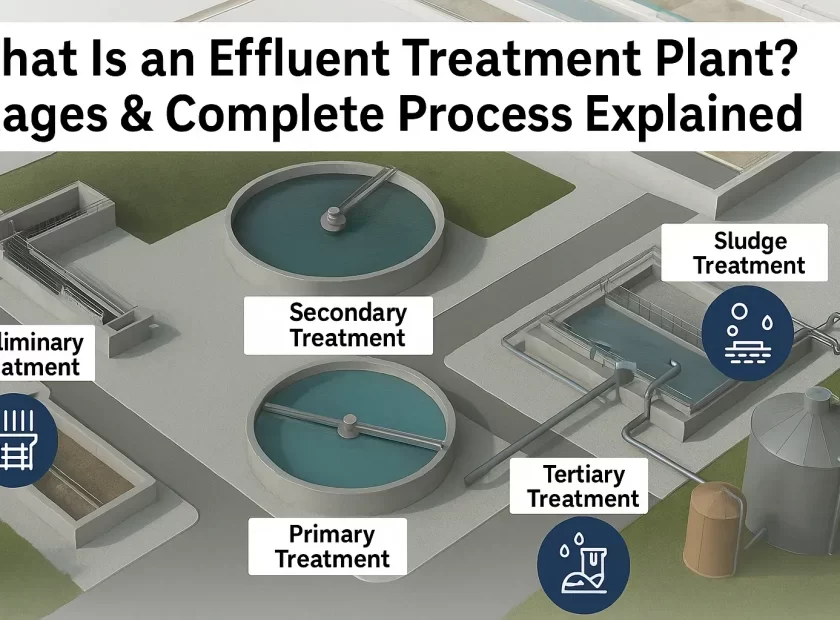
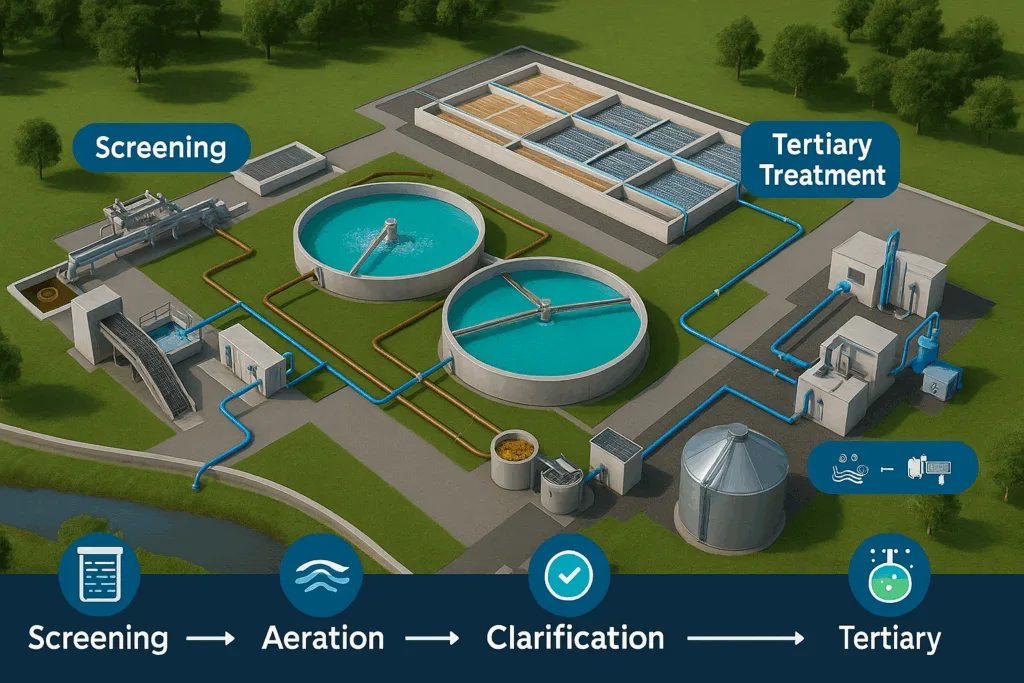
Stages of Sewage Treatment: How an STP Works
Every STP follows a sequence of stages designed to gradually remove impurities. These steps ensure the wastewater is treated to meet regulatory standards.
Let’s go through each stage:
- Preliminary Treatment – Removing Large Impurities
This is the first line of defense, where big, bulky materials are removed to protect downstream equipment.
Processes include:
- Screening (removes plastics, rags, hair, debris)
- Grit Removal (removes sand, silt, gravel)
- Oil & Grease Trap (removes fats and oils)
Preliminary treatment ensures the rest of the STP runs smoothly without clogging.
- Primary Treatment – Settling of Suspended Solids
Here, wastewater enters a primary settling tank (also called a sedimentation tank).
What happens:
- Heavier particles settle at the bottom as sludge
- Light materials float and are skimmed off
- Organic load reduces before entering the biological stage
Primary treatment removes 30–40% of the suspended solids.
- Secondary Treatment – Biological Treatment (Heart of the STP)
This is where harmful organic matter is broken down using microorganisms.
Common technologies include:
- MBBR (Moving Bed Biofilm Reactor)
- MBR (Membrane Bioreactor)
- SBR (Sequencing Batch Reactor)
- Activated Sludge Process (ASP)
How it works:
Microbes consume organic pollutants (BOD/COD) and break them down into harmless by-products. Aeration systems supply oxygen to keep these microorganisms healthy and active.
This stage removes 85–95% of organic contamination.
- Secondary Clarification – Settling of Biomass
After biological treatment, the water flows into a secondary clarifier.
What happens here:
- Biomass (sludge) settles at the bottom
- Clear treated water overflows
- A portion of sludge returns to maintain biological balance
- Excess sludge goes for further processing
This step ensures the final treated water is clear and free from suspended solids.
- Tertiary Treatment – Final Water Polishing
Tertiary treatment improves the water quality further so it meets CPCB discharge norms and is safe for reuse.
Common tertiary processes include:
- Pressure sand filter (PSF)
- Activated carbon filter (ACF)
- Dual media filter (DMF)
- Ultrafiltration (UF)
- Membranes (in MBR systems)
This stage removes fine particles, colour, odour, and residual contaminants.
- Disinfection – Killing Harmful Pathogens
Before reuse or discharge, treated water is disinfected using:
- Chlorination
- UV disinfection
- Ozonation
This ensures the water is free from harmful bacteria and viruses.
- Sludge Treatment & Disposal
All sludge collected from the primary and secondary stages is processed through:
- Sludge drying beds
- Filter press
- Centrifuge
- Composting
- Anaerobic digestion
Proper sludge handling is essential to avoid secondary pollution.
Why Do We Need an STP?
A well-designed STP ensures:
- Compliance with CPCB guidelines
- Pollution-free discharge
- Odour-free operation
- Reduced water consumption through reuse
- Environmental protection
- Higher property and project value
In urban India, an STP is not just a requirement — it’s an environmental necessity.
Need an STP or Want to Upgrade an Existing One?
Whether you need a new STP, want to upgrade to MBBR/MBR, or want expert advice on compliance, Venza offers end-to-end solutions designed for efficiency, performance, and sustainability.
For any assistance or related queries:
📞 Call: +91-9999724878
📧 Email: enquiry@venzawater.com
Our experts will guide you with the right wastewater treatment solution for your project.